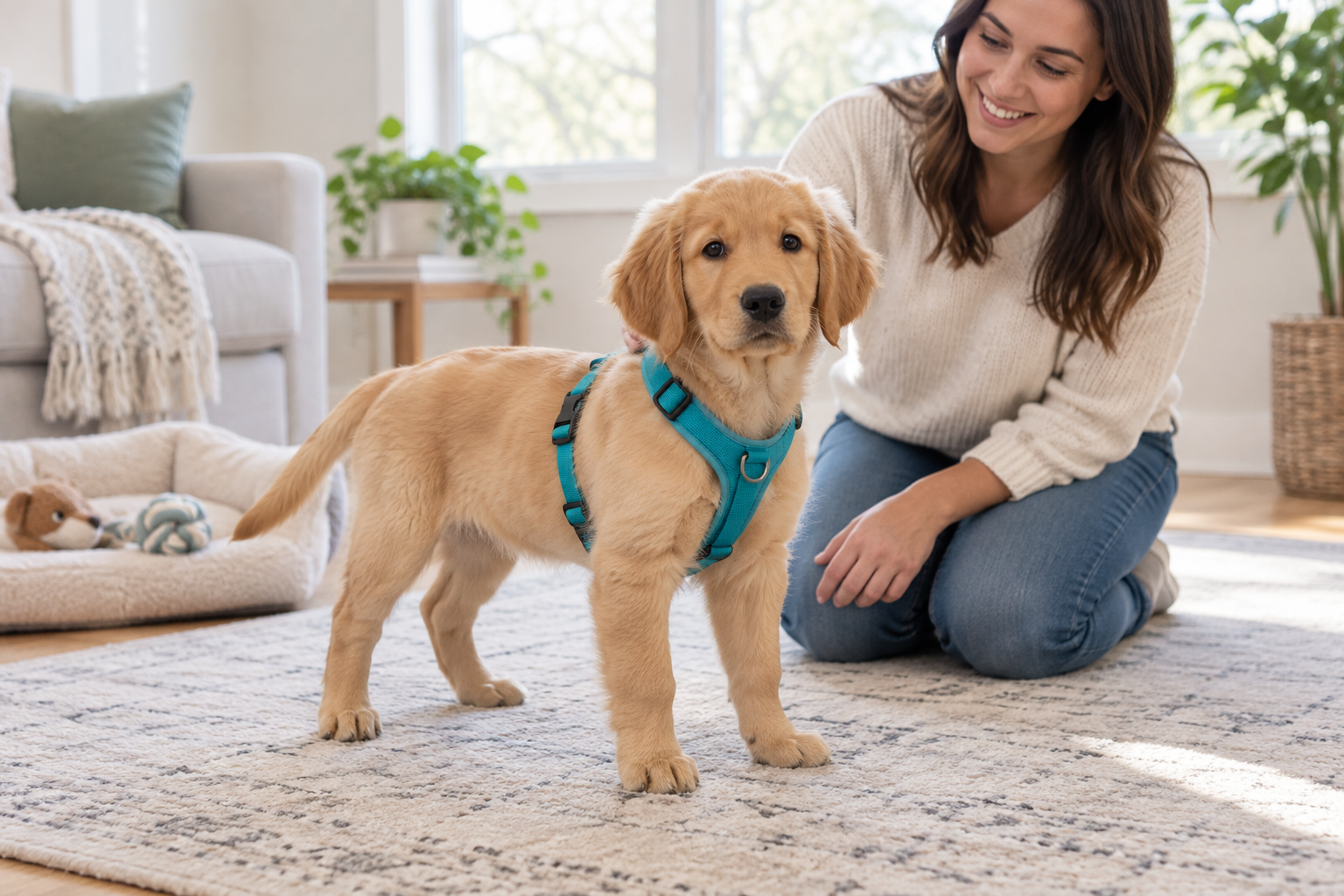
Your puppy's first harness should fit the puppy you have today. Choose an adjustable puppy harness using current measurements, then check its fit as your dog grows. This guide explains what to compare before buying, gives you a growth adjustment checklist, and helps you decide when to replace a puppy harness.

Start with the dog harness size chart and measuring guide. Save the exact model name and chart alongside your measurements: a size label from another harness is not a reliable shopping shortcut.
Buy for current measurements, with usable adjustment left
Ruffwear's puppy sizing guidance recommends measuring the puppy as it is now. Its larger-size example works because the puppy already falls within that size's range. That is different from buying a harness the puppy cannot yet wear securely.
Use a flexible measuring tape at the locations specified by the product manufacturer. Ruffwear measures girth around the widest rib-cage area behind the front legs. Other products can require additional measurements. Record inches or centimeters consistently; label the units rather than writing an unexplained number in your phone.
On your shortlist, write down the smallest and largest stated measurements for each candidate. Check every required measurement, not just the one with the most growing room. A chart match is the starting point; the indoor fitting check still matters.
What to compare in an adjustable puppy harness
| Shopping question | What to record |
|---|---|
| Does this size fit now? | Today's measurements and the exact model's stated size range. |
| Where does it adjust? | Neck and body adjustment points shown in the product instructions. |
| How does it go on? | Head opening, neck buckle or step-in leg loops; consider handling your puppy already accepts. |
| Which ring takes the leash? | The manufacturer's designated walking attachment; do not guess from the presence of a loop. |
| Can you return a poor fit? | The seller's current return conditions before removing tags or using it outdoors. |
These are comparison prompts, not a product ranking. An extra buckle or adjustment point is useful only if it helps this harness fit your puppy and makes it practical for you to use.
Introduce the harness before the first walk
Dogs Trust's harness introduction starts with letting the dog investigate the equipment and building positive associations gradually. It recommends going back a stage if the dog retreats and stopping when handling causes worry.
Choose a calm indoor setting. Let your puppy investigate, introduce the buckle sound, and work toward fastening the harness without forcing the head or legs through. Once it is on, encourage a few comfortable steps. Follow the product's clearance instructions and watch whether the straps stay in place without restricting movement. For more on the putting-on choice, see step-in vs overhead dog harnesses.
Puppy harness growth adjustment checklist
This is a Tail & Paw recording aid, not a tested growth schedule. Use the quick checks before an outing. Take fresh measurements when fit changes or you are considering a new size. The boxes are temporary and reset on reload; print the page or keep a copy in your phone.
| Date | Chest girth + units | Other required measurements | Model / size | Adjustment and next action |
|---|---|---|---|---|
| Enter date | Enter measurement | Enter measurements | Enter model and size | Keep / refit / replace |
When to adjust and when to replace the harness
Planning car journeys as well as walks? Read car harness vs walking harness before treating a leash harness as a vehicle restraint.
Use this decision checklist when something changes. It is an editorial way to organize the fitting task, not a guarantee that a harness cannot come off.
- Adjust and reassess: the harness has usable adjustment available and can still meet its fitting instructions.
- Choose another size or shape: you cannot obtain a comfortable, secure fit within the product's adjustment range.
- Stop using damaged equipment: check the maker's replacement advice if a buckle, attachment, seam or strap is damaged.
There is no replacement date supplied by this checklist: the record follows the individual puppy and product. For a slipping harness, use our harness escape-fit guide; for strap discomfort, see harness rubbing behind the front legs. Avoid trying to solve either problem by automatically tightening every strap.
Sources checked September 15, 2026: Ruffwear's measuring and puppy sizing guide; Dogs Trust's harness training guide. The recording checklist is an editorial aid; no hands-on product test or veterinary review is claimed.