Measure your dog's chest girth, then compare it with the size chart for the exact harness you're buying. Some harness models also require a neck measurement or a measurement across the front of the chest. A size label on its own cannot tell you whether the harness will fit.

Between sizes? The answer depends on the harness. Ruffwear says to go larger for its Front Range; PetSafe says to go smaller for its 3 in 1. Use the chart and comparison below to find the instructions that apply to your purchase.
Key takeaways
- Start with the exact product's measurement instructions.
- Chest girth means a full loop around the rib cage. A front-chest measurement is different.
- Follow the harness model's between-size guidance, then check the harness on your dog.
- Keep a measurement record so you can compare products without relying on memory.
Why I stopped trusting the word “Medium”
I once bought a Medium harness that fit my dog like a cape. A Medium from another brand was so tight I couldn't get it over his head. I thought I was getting something wrong. Seeing that two harnesses can even have opposite advice about sizing up or down made those purchases make more sense.
That's why I find a chart with actual inches and centimeters more useful than a size label. I can compare my dog's measurements with the numbers on my phone instead of guessing what “Medium” means this time.
I'm less convinced I'll print a worksheet, though I probably should. I've measured my dog, written the number on my hand, then washed it off before getting to the store. Saving the measurements in my phone would solve that problem too. The useful part is having the numbers with me when I buy.
Owner perspective supplied for this article and edited for clarity. The brands involved in these purchases were not identified; this account is separate from the manufacturer comparison below.
Dog harness size chart: a real manufacturer example
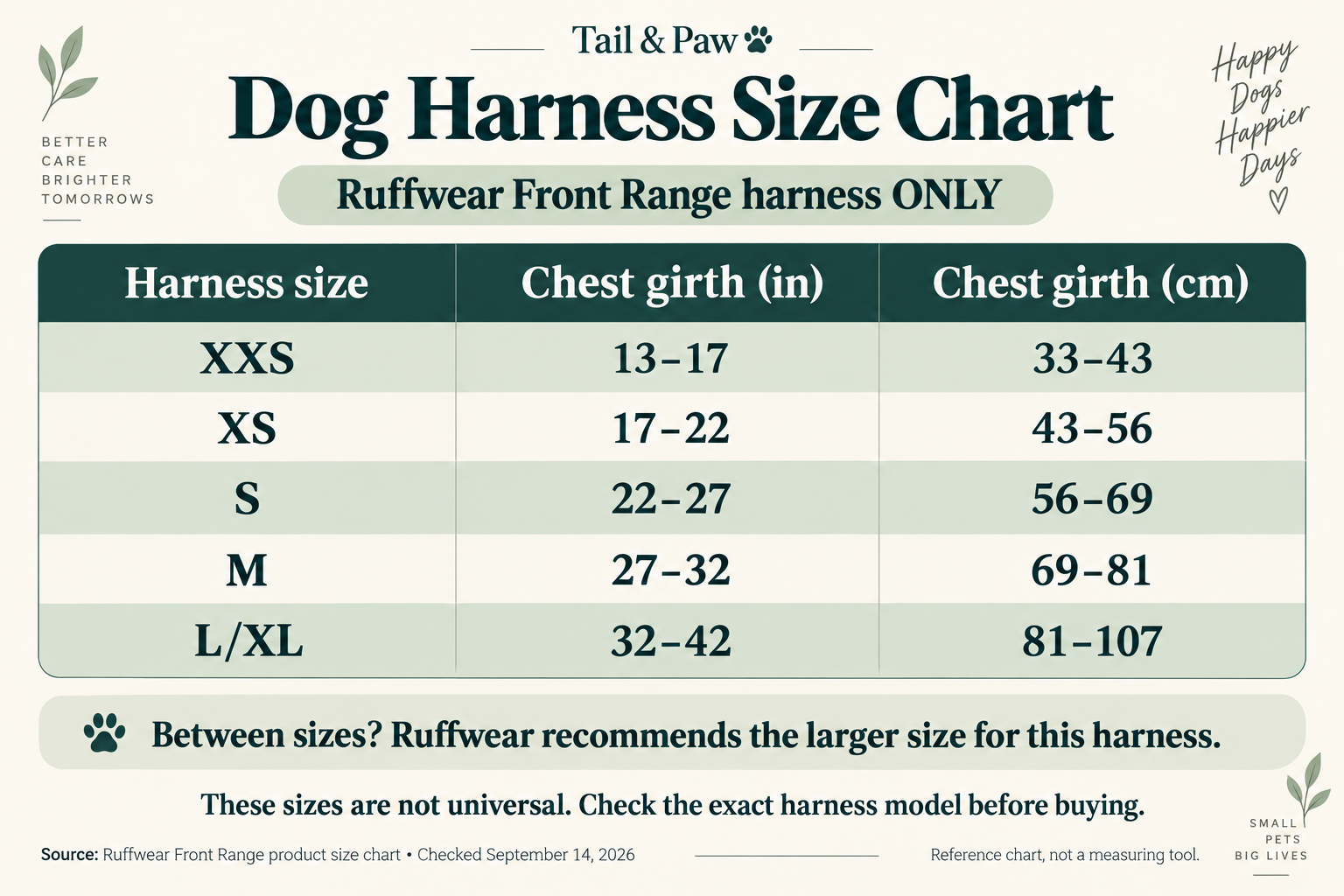
The following measurements apply to the Ruffwear Front Range harness. They are not universal small, medium, or large dog sizes.
Tail & Paw illustration using Ruffwear's published measurements. This is a reference chart, not a measuring tool; keep the text table below for easy reading.
| Front Range size | Chest girth, inches | Chest girth, centimeters |
|---|---|---|
| XXS | 13–17 | 33–43 |
| XS | 17–22 | 43–56 |
| S | 22–27 | 56–69 |
| M | 27–32 | 69–81 |
| L/XL | 32–42 | 81–107 |
Source: Ruffwear Front Range product sizing chart, checked September 14, 2026. The centimeter ranges are the manufacturer's published values. Check the current product page before ordering.
Illustrative example: A dog with a 25-inch chest would start with Small in this harness model. You would still need to adjust it and check the fit on the dog. This is a chart-reading example, not a result from hands-on testing.
Breed and weight can help you browse products, but the product-specific measurements are what you need to choose among these sizes.
How to measure your dog for a harness
Have a flexible tape measure and somewhere to record the result. Read the product's measuring diagram before starting, especially if it asks for both “chest” and “girth.”
1. Measure the chest girth
With your dog standing comfortably, wrap the tape around the widest part of the rib cage, just behind the front legs. Keep the tape flat rather than twisted. Record the number and its unit.
If you do not have a flexible tape, use a non-stretching piece of string, mark where the ends meet, and measure that length against a ruler. This follows Ruffwear's measuring method.
Take a second reading before putting the tape away. If the numbers differ, check your dog's stance and the tape's position, then measure again.
2. Measure the other areas the harness model requires
For the PetSafe 3 in 1, the manufacturer asks for girth and a measurement around the base of the neck, starting just above the shoulder blades. Follow that location rather than assuming the dog's existing collar length is the right number. PetSafe 3 in 1 measuring instructions
The PetSafe Easy Walk uses a different additional measurement: across the front of the chest, starting approximately one inch behind one front leg and ending approximately one inch behind the other. It also requires the full girth measurement. PetSafe Easy Walk measuring instructions
For that harness model, PetSafe specifies a snug measurement close to the skin, moving fluffy fur aside if needed. Follow your chosen harness model's tape-position and tension instructions rather than measuring loosely over the coat.
This distinction matters when comparing charts. “Chest” may describe a full circumference on one page and an across-the-front measurement on another. Check the diagram, not just the column heading.
3. Compare all required measurements
Save the product name alongside the numbers. Print the measurement worksheet, or save the same details in a note on your phone:
| Record | Your notes |
|---|---|
| Date measured | |
| Dog's name | |
| Brand and exact harness model | |
| Chest girth and unit | |
| Neck measurement, if requested | |
| Across-front chest measurement, if requested | |
| Size suggested by the current chart | |
| Manufacturer's between-size instruction | |
| Result after trying the harness |
For clothing measurements, including back length, see our dog clothing size guide. Keep those garment measurements labeled separately from the harness record.
Between sizes? Check the harness model's rule
There is no single size-up rule that applies to every harness. These official instructions show why:
| Harness | Measurements requested | Manufacturer's between-size guidance |
|---|---|---|
| Ruffwear Front Range | Chest girth | Choose the larger size |
| PetSafe Easy Walk | Across-front chest and girth | Choose the larger size or the size with the best girth match |
| PetSafe 3 in 1 | Girth and base of neck | Size down |
Comparison of public manufacturer instructions checked September 14, 2026; no hands-on product testing was performed for this article.
The two PetSafe harness models give different advice. Even within one brand, check the harness model name before following a sizing rule.
If the neck fits one size but the chest fits another, send both measurements to the manufacturer before ordering. Ask which size or alternative harness model accommodates both. Do not force a choice by ignoring one measurement.
Check the fit while your dog moves
Try the adjusted harness indoors before relying on it for a walk.
Dogs Trust's harness guidance emphasizes unrestricted movement, straps that stay in position, and a fit the dog cannot slip out of. It also recommends introducing the harness gradually and stopping if the dog is worried.
Use the product's fitting instructions for strap placement and tightness. Then make these observations in a secure indoor space:
- Standing: Are the straps flat, with the panels positioned as the manufacturer shows?
- Walking and turning: Does the harness stay in place, and can your dog move comfortably?
- Sitting: Do the panels remain positioned without visibly bunching?
- After removing it: Is there any rubbing or irritation where it touched the body?
Do not try to prove security by pulling a frightened dog backward through the harness. If the harness shifts markedly or your dog appears able to slip out, stop the trial and seek fitting help before using it outdoors.
If handling or wearing the harness appears painful, or you notice skin damage, stop using it and contact your veterinarian. Tightening the straps is not a substitute for investigating discomfort.
What about a growing puppy?
Choose a harness that fits the puppy now and has adjustment available within the appropriate size range. Do not treat a loose current fit as acceptable simply because the puppy may grow into it.
Ruffwear's puppy guidance illustrates the distinction: its size-up example applies when the puppy's current girth already falls within the larger size's range. It does not recommend buying an arbitrarily oversized harness. Ruffwear's puppy sizing guidance
Keep successive measurements in your worksheet. Recheck the fit as your puppy grows and before relying on a harness that has been stored away. Record when an adjuster reaches its limit so the next purchase starts with current measurements.
Before you order: record the measurements, save the exact harness model's chart, and read the exchange conditions. When the harness arrives, use your worksheet to record how it actually fits. That gives you something more useful for the next purchase than “we usually buy medium.”