A harness label tells you less than its attachment points, shape and fit. Use this guide to compare the design you are considering, then check the exact product's measurement chart before buying.

Start with our dog harness size chart for chest girth, neck and model-specific measuring instructions.
Front clip and back clip mean different leash positions
A back clip sits over the dog's back. A front clip sits at the chest. The leash therefore pulls from a different direction when the dog reaches the end of it. Ruffwear describes its Front Range as having both a back V-ring for everyday walks and a reinforced chest attachment that can redirect dogs who pull. That is a product description, not a guarantee that the harness will stop pulling.
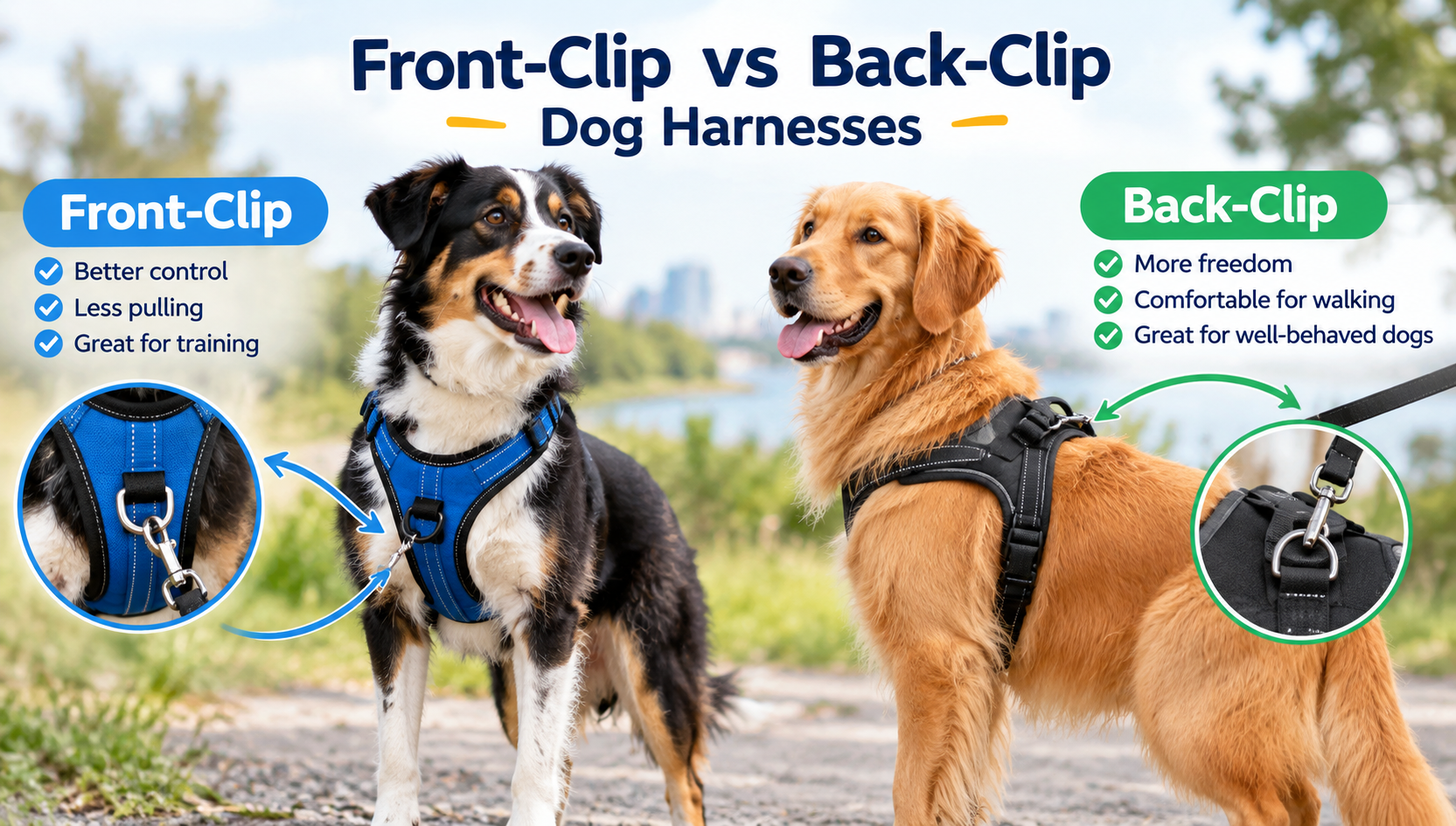
Back-clip harnesses: simple for everyday walking
A back clip is often straightforward to connect and easy to find while you are walking. It can suit a dog who already walks comfortably on lead and an owner who wants a familiar attachment point. Check that the harness does not cross the front of the shoulders or restrict natural movement; Dogs Trust warns that some designs can do this.
A back clip is not a substitute for teaching loose-lead walking. If your dog surges, the leash pressure still travels through the harness and the dog may continue rehearsing that pattern.
Front-clip harnesses: useful for redirecting, not magic
A front attachment can turn the dog's chest toward the leash when the dog moves ahead. That change can give you a different handling option during training. It does not make a dog “no pull” by itself, and it should not be used to jerk, drag or punish a dog.
Choose a design whose front attachment sits where the maker shows it. If the harness rotates, rubs or shifts toward the neck, stop and recheck the size and adjustment.
Which attachment should you choose?
| Question | What to consider |
|---|---|
| Does your dog already walk calmly? | A back clip may be the simpler everyday option. |
| Are you working on pulling? | A front clip may offer a redirecting attachment; pair equipment with reward-based training. |
| Does your dog dislike handling? | Prioritize a design you can introduce gradually and fit without forcing the head or legs. |
| Does either design restrict movement? | Stop using it and seek a better-fitting or differently shaped harness. |
For putting-on style, compare the step-in and overhead harness guide when it is live. For fit troubleshooting, see the planned harness rubbing guide when published.
Check either attachment before walking outside
- Measure the exact harness model using its instructions.
- Adjust it indoors while your dog is calm.
- Check that straps stay flat and do not restrict shoulder movement.
- Walk a few steps and turn. Check that the harness stays in place.
- Stop if your dog shows pain, fear, rubbing or an ability to slip out.
Dogs Trust recommends a comfortable fit that stays in position while the dog moves and cannot be slipped out of. Introduce new gear gradually with rewards, and involve your veterinarian or a qualified behaviorist if handling is worrying.